


UPI


UPI, or Unified Payments Interface, is India's instant payment system for transferring money directly between bank accounts. Developed by the National Payments Corporation of India (NPCI), an RBI-regulated entity, UPI lets you send and receive money through a UPI-enabled app using a UPI ID, mobile number or QR code.
Unlike a traditional bank transfer, you usually don't need to enter the recipient's account number and IFSC code. You can link one or more bank accounts to a UPI app and make payments from your phone, including transfers to individuals, merchant payments and bill payments.
In this guide, we'll explain what UPI is, how UPI works, how to use it, what a UPI ID is, how UPI payments are secured and how UPI differs from other digital payment methods.
What is UPI?
UPI stands for Unified Payments Interface. It is India's instant payment system that allows people to send and receive money directly between bank accounts through a UPI-enabled app. Developed by the National Payments Corporation of India (NPCI), UPI connects participating banks and payment providers to process transactions in real time.
You can make a UPI payment using a UPI ID, mobile number, QR code or other supported payment methods. Unlike a traditional bank transfer, you usually don't need to enter the recipient's bank account number and IFSC code.
What Is a UPI ID?
A UPI ID, also called a Virtual Payment Address (VPA), is a unique payment address linked to your bank account. It allows you to send or receive money through UPI without sharing your bank account number and IFSC code with the other person.
UPI = payment system
UPI ID = payment address used within that system
UPI PIN = secret code used to authorise a transaction
UPI ID vs UPI Pin
UPI ID | UPI PIN |
|---|---|
Identifies your UPI payment address | Authorises a bank transaction |
Can be shared to receive money | Must never be shared |
May look like | Usually a 4–6 digit PIN |
Used to identify the recipient | Used to authenticate the payment |
NPCI specifically states that the UPI PIN is a 4–6 digit passcode used to authorise bank transactions and should not be shared.
How UPI Works?
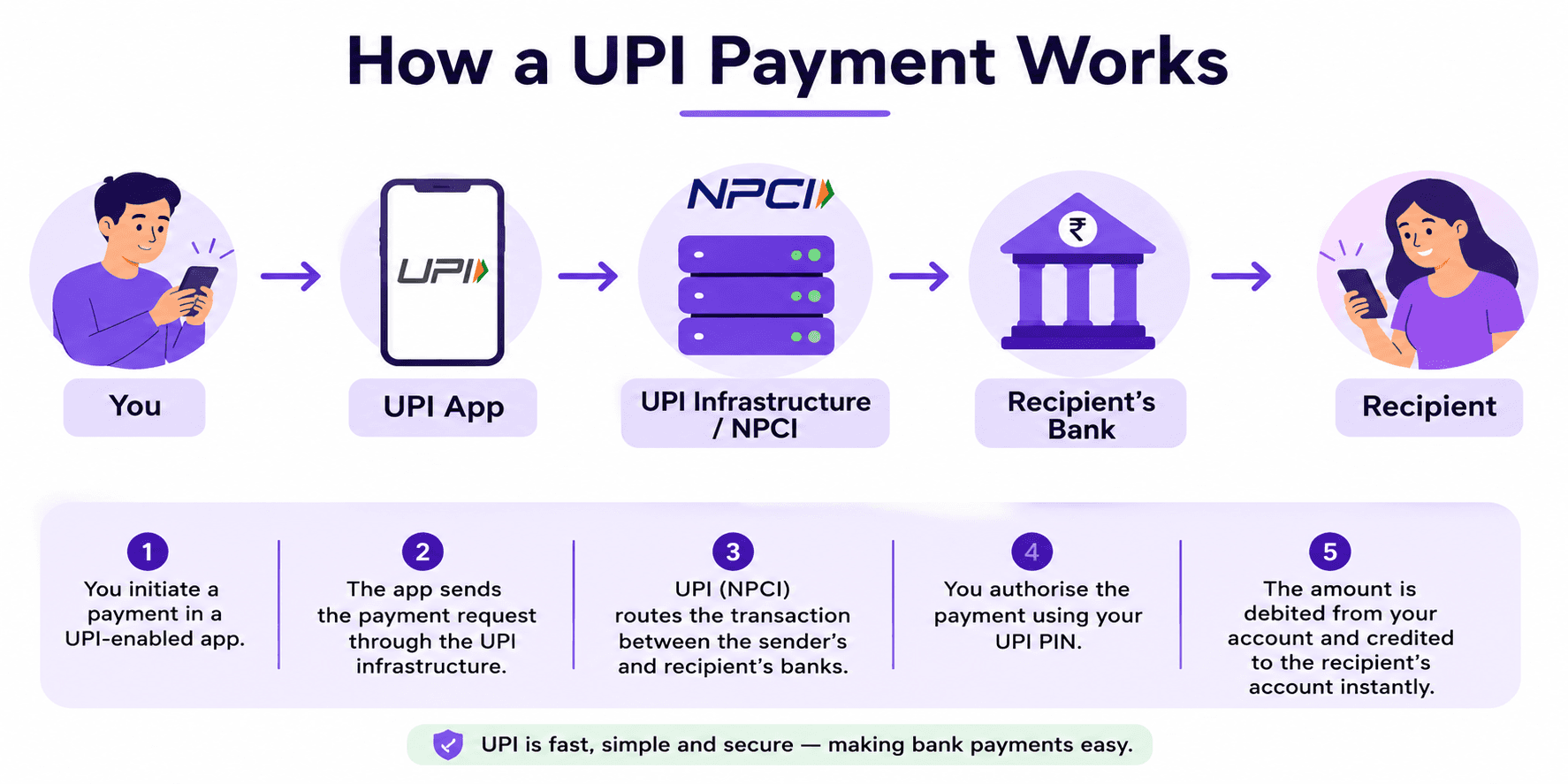
1. Link your bank account
You link your eligible bank account to a UPI-enabled app using the mobile number registered with your bank.
2. Choose how you want to pay
You can initiate a payment using a UPI ID, mobile number, QR code or other supported payment method.
3. Confirm the payment
Enter the amount, verify the recipient details and authorise the transaction using your UPI PIN.
4. Money moves between bank accounts
The UPI infrastructure routes the transaction between the participating banks, and the amount is debited from the sender's account and credited to the recipient's account.
Who Is Involved in a UPI Transaction?
Participant | Role |
|---|---|
Customer | Initiates or receives the payment |
UPI app / PSP | Provides the interface to initiate the transaction |
Remitter bank | Debits the sender's account |
Beneficiary bank | Credits the recipient's account |
NPCI | Operates the UPI payment infrastructure |
RBI | Regulates the broader payment-system framework |
What Are the Key Features of UPI?
Here are the primary features of UPI:
Instant bank transfers: Money can move between participating bank accounts in real time.
24/7 availability: UPI payments are available around the clock, including weekends and holidays.
Multiple payment methods: Users can pay through UPI IDs, QR codes, mobile numbers and supported payment flows.
Multiple bank accounts: Several eligible bank accounts can be linked to a UPI app.
Interoperability: You can generally pay a recipient even when they use a different UPI app.
PIN-based authorisation: The UPI PIN is used to authorise bank transactions.
How to Send Money Using UPI
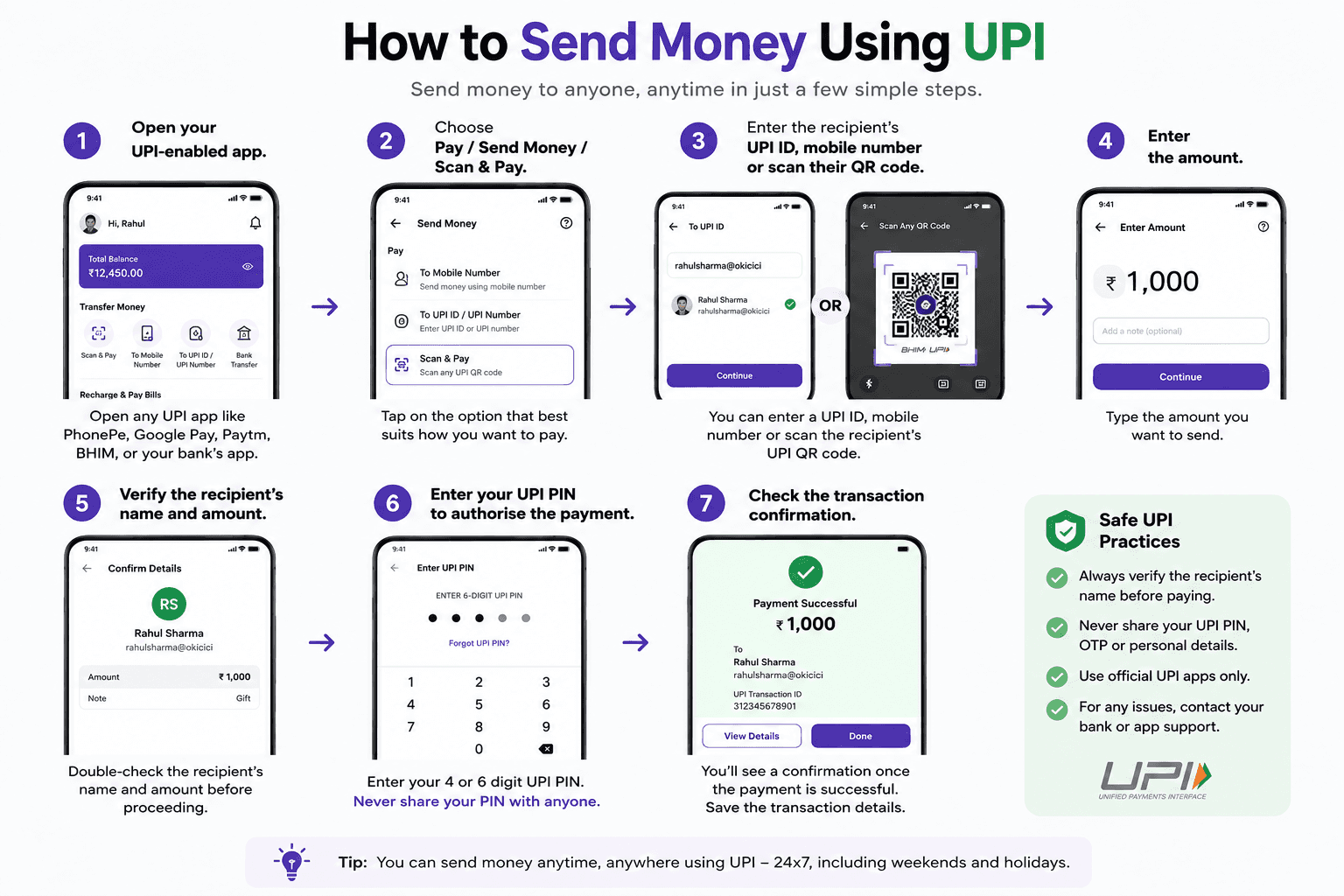
Open your UPI-enabled app.
Choose Pay / Send Money / Scan & Pay.
Enter the recipient's UPI ID, mobile number or scan their QR code.
Enter the amount.
Verify the recipient's name and amount.
Enter your UPI PIN to authorise the payment.
Check the transaction confirmation.
How to Receive Money Using UPI
To receive money, share your UPI ID or personal UPI QR code with the sender. The sender initiates and authorises the payment from their UPI app. You do not need to enter your UPI PIN to receive money.
Is UPI Safe?
UPI uses multiple security controls, including device and mobile-number verification and UPI PIN-based transaction authorisation. However, the security of a payment also depends on how you use the system. Never share your UPI PIN or OTP, and always verify the recipient's name and payment amount before authorising a transaction. NPCI specifically advises users not to share their UPI PIN.
Common UPI Scams to Watch Out For
Fake payment requests
Don't approve an unexpected payment request.
Fake customer support
Don't share your UPI PIN or OTP with someone claiming to be from your bank or UPI app.
QR-code scams
Scanning a QR code is generally used to make a payment, not to receive one. If someone asks you to scan a QR code to receive money, stop and verify the request.
Fake refund offers
Don't enter your UPI PIN to "receive" a refund.
UPI vs NEFT vs IMPS vs RTGS
Feature | UPI | IMPS | NEFT | RTGS |
|---|---|---|---|---|
Main use | Everyday digital payments & transfers | Instant bank transfers | Electronic bank transfers | High-value real-time transfers |
Access | UPI-enabled app | Bank/app | Bank/app | Bank/app |
Payment address | UPI ID/QR/mobile number etc. | Account details | Account details | Account details |
Availability | 24/7 | 24/7 | 24/7 | 24/7 |
Typical experience | Quick, app-based | Bank-transfer based | Bank-transfer based | High-value bank transfer |
Benefits of UPI
UPI offers some brilliant benefits for both customers and merchants. Let’s have a look.
For Customers:
Increased Customer Convenience - Customers may pay using UPI straight from their bank accounts, doing away with the need for cash or credit cards. This is a great way to improve customers’ payment experience. Moreover, UPI payments are accepted by a huge number of online and offline merchants, including utility providers, e-commerce businesses, retail stores, etc., making UPIs more popular among users.
Secured Transactions - UPI encrypts data and also uses multi-factor authentication to safeguard financial information, reduce the risk of fraud, and build trust.
Access to Transaction Data - Customers get real-time notifications for successful transactions. They can also view transaction history to keep track of expenses.
For Merchants:
Faster Settlement - Merchants can receive payments promptly due to UPI's facilitation of real-time transactions. In addition to reducing settlement times, this enhances cash flow.
Cost-Effectiveness - Compared to conventional payment options like credit cards, UPI transactions usually have cheaper transaction rates. This reduces transaction costs for retailers, particularly in cases of large transaction volume.
Wide Customer Reach - A vast consumer base can utilise UPI because it is accepted by several banks and service providers. By attracting clients from several banks, merchants may access a wider market.
Enhanced Business Insights - Merchants may analyse client behaviour, monitor sales trends, and make well-informed business choices by utilising the detailed transaction data that UPI transactions give.
Are UPI Payments Free?
There is generally no charge for ordinary consumer UPI transactions, but fees can depend on the type of transaction, participant and applicable rules. Check your bank or payment provider for any applicable charges.
UPI Payment Rules
The UPI transaction limit for regular UPI transactions is INR 1 lakh per day according to NPCI. Moreover, NPCI permits up to 20 UPI transactions per day. The maximum UPI daily transfer limit might range from INR 25,000 to INR 1 lakh, depending on the bank.
What Makes UPI Unique?
UPI simplifies the payment ecosystem and removes time limits for both people and enterprises, in contrast to conventional techniques like RTGS or NEFT. With several encryption layers and a highly secure layered design, it guarantees the security and integrity of data while conducting transactions.
The UPI Transaction Flow
PUSH - Streamlined Payment Initiation and Authorisation
Here's how unified payment interface works when initiating payment:
Phase 1: Transaction Initiation and Authorisation
The customer begins by providing the recipient's details and transfer amount. The UPI-enabled app forwards the transaction request to the chosen PSP which then routes the request to the NPCI to oversee the transaction. The sender's bank verifies the balance, customer credentials, and transaction's authenticity. If all information is correctly verified, the bank generates a digital signature for information security.
Phase 2: Verification and Fund Transfer
In phase two, the PSP shares the sender's bank details with the UPI system. The account balance and fund availability are then checked by NPCI before triggering fund deduction. The UPI server sends a notification as soon as the funds are transferred to the receiver's account.
PULL - Controlled Payment Requests and Execution
In the Pull transactions, the recipient requests payments. Here's the process -
Phase 1: Transaction Initiation and Payment Message Flow
As soon as the recipient generates a payment request, it flows to the NPCI signalling the intention to pull funds.
Phase 2: Transaction Flow between Banks
The payment request reaches the receiver's bank and is then forwarded to the sender's bank. The debtor's bank verifies the request as well as the available balance. The payment goes through if the bank approves the requested transaction based on the fund's availability.
Different Ways to Transfer Funds via UPI
You can send money using UPI in multiple ways:
Contact or Mobile Number - You can input the transfer amount, your PIN, and either a contact from your phonebook or a cell number to make a transfer.
UPI ID - The sender can enter the receiver's UPI ID, also known as Virtual Payment Address (VPA), to transfer funds. A VPA is a unique identifier to track bank accounts.
QR Code - You can transfer money via UPI by scanning the receiver's QR code. Every user is given a unique QR code to accept payments.
Account Number & IFSC Code - This is the standard payment mechanism that UPI accepts as well. You can provide the recipient's account number and IFSC to initiate a transaction
How to Use UPI on Freo?
Here are the simple steps to use UPI on Freo:
Select the Scan and Pay option either from the payments page or the home screen.
Enter the desired transfer amount.
Enter the OTP that you received on your registered cell phone number.
To maintain a safe and secure transaction experience, keep your UPI PIN confidential and use caution while handling your financial and personal information.
Say Hi 👋 to Freo UPI Anytime Anywhere Scan & Pay with UPI Instant Transfer
FAQs
Is UPI an app or a payment system?
UPI is a payment system, not an app. It is the infrastructure that enables participating banks and payment apps to process instant bank-to-bank payments. Apps such as Google Pay, PhonePe, Paytm, BHIM and bank apps provide access to UPI.
Do I need a UPI PIN to receive money?
No. You do not need to enter your UPI PIN to receive money. The sender authorises the payment from their UPI app. Never enter your UPI PIN because someone says they are sending you money.
Who regulates UPI?
UPI was created by the National Payments Corporation of India (NPCI), which also oversees it. The Reserve Bank of India controls UPI.
What if I enter the incorrect UPI-PIN when making a transaction?
If you input the wrong UPI PIN, the transaction will be unsuccessful. If you keep entering the wrong UPI PIN, your bank may temporarily block you from using UPI to transfer money.
What should I do if I forget my UPI PIN?
You must reset your UPI PIN using the last six digits of your debit card and the expiration date.
Is UPI safe?
UPI is secure as it is based on two-factor authentication. The Reserve Bank of India is in charge of overseeing UPI regulation to prevent fraud and conduct transactions only between authorized banks. In addition, every UPI transaction is secured by a unique MPIN that is known only to the sender.
Are UPI ID and UPI PIN the same?
No, the UPI ID and PIN are not the same. Payees must have access to your virtual payment address, or UPI ID for them to be able to send funds to your account. On the other hand, a UPI PIN is like a password to authenticate payments from your account.
What is VPA in UPI?
A Virtual Payment Address (VPA) is a special code that aids in account tracking for UPI users. In essence, it enables identification regardless of your bank account number or other information.
What is UPI PIN or mPIN?
The mPIN is a password of four to six digits which is required to transmit money over UPI, just as the ATM PIN.
Is UPI free?
Yes, UPI is now free, but according to certain media sources, it could eventually cost a fee. The fee is anticipated to be around INR 0.5 for each transaction.
What is the daily UPI transaction limit?
A person can conduct up to 20 fund transfer transactions per day using UPI, which has a daily transaction limit of INR 2 lakhs. Bill payments, collect requests and merchant transactions are not included in this cap.
Can I link my UPI ID with multiple accounts?
Yes, If the bank or provider permits it, you may link your UPI ID to several bank accounts using the UPI app.
Can I send money to someone who is not registered with UPI?
Yes, the recipient's bank account number, IFSC code, and name are among the essential data you must submit in order to send money to someone who is not registered on a unified payment interface.
Naina Rajgopalan
Naina Rajgopalan has a thing for numbers and a deep fascination to learn about all things finance. She's been money-wise from a young age and has always shared her knowledge and tips with those around her. Being a part of the content team at Freo, a neobank that offers flexible and customised financial products, along with benefits such as insurance on balance, safe & secure banking, and so on, Naina stays updated with the latest of what happens in the banking and fintech industries. She has taken upon herself to share her knowledge with readers across all walks of life to help them manage their finances and budgets better, so they can make better decisions while spending, borrowing, investing and saving.